
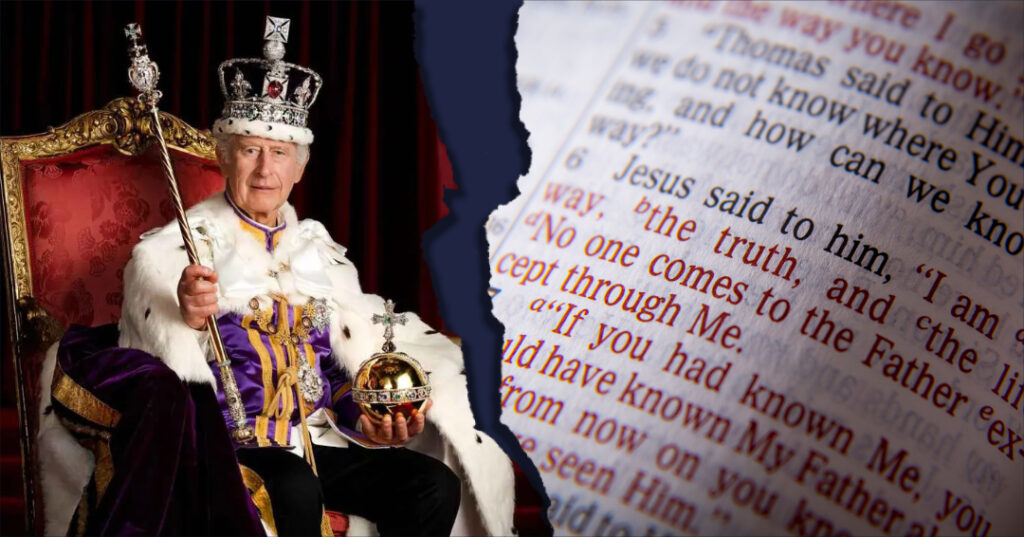
Since 1543, when it was conferred on Henry VIII by the Parliament of England, every English (later British) sovereign has held the title “Defender of the Faith”, (except Mary I, a Catholic), and by Each new sovereign reinforces this at their coronation. At Charles III’s, he was handed a Bible with these words:
Sir, to keep you ever mindful of the law and the Gospel of God as the Rule for the whole life and government of Christian Princes, receive this Book, the most valuable thing that this world affords. Here is Wisdom; this is the royal Law; these are the lively Oracles of God.
The Coronation Oath itself binds the sovereign to preserve Protestant Christianity in the state. In the ceremony, the King promised:
Archbishop: Will you to the utmost of your power maintain the Laws of God and the true profession of the Gospel? Will you to the utmost of your power maintain in the United Kingdom the Protestant Reformed Religion established by law? Will you maintain and preserve inviolably the settlement of the Church of England, and the doctrine, worship, discipline, and government thereof, as by law established in England?
…King: All this I promise to do.
King Charles went further in his vow, declaring before God:
I Charles do solemnly and sincerely in the presence of God profess, testify, and declare that I am a faithful Protestant, and that I will, according to the true intent of the enactments which secure the Protestant succession to the Throne, uphold and maintain the said enactments to the best of my powers according to law.
The king then acknowledges that he is serving under God and asks in prayer that he might receive knowledge of God’s truth.
Just a ceremony?
Some will say this is just ceremony and tradition with no binding power. Scripture disagrees:
When thou shalt vow a vow unto the LORD thy God, thou shalt not slack to pay it: for the LORD thy God will surely require it of thee; and it would be sin in thee.
Deuteronomy 23:21
This command was singled out from the Mosaic law and named as sin – which makes it binding on all people, in all times, not only Israel under Moses.
Our king said, “I solemnly promise”, “All this I promise to do”, and “I … do solemnly and sincerely in the presence of God profess, testify, and declare”. These words are the language of a solemn vow made before God.
On 25th June, the annual Sovereign Grant report was published. That may sound like a good read to send you off to sleep, but under “The Official Duties of the Sovereign” it states:
His Majesty is Supreme Governor of the Church of England and protects the space for Faith within the multi-faith nation. [Emphasis mine]
In this official report from the House of Commons, the king is no longer “Defender of the Faith” but merely protector of “the space for Faith”, all kinds of faith.
This is huge, a bombshell declaration. For centuries, our rulers have defined this land as a Christian nation, not meaning that every citizen is a Christian, but that our laws and values rest on a Christian and Biblical foundation, while individuals remain free to believe otherwise.
Abandoning this definition opens the nation to mutually exclusive worldviews, as if religion is merely decoration, cultural artistry, rather than a rival claim to truth.
More than tradition
Religion is not liturgy, clothing, or music. It is morality – the basic principles of right and wrong that define a society: the dignity of all life or the supremacy of one group over others; blind justice or discriminating justice; living peaceably or under subjugation. But it also deals with eternity – the ultimate destination of the soul. Once entered, it cannot be changed, and therefore it is vital we have the truth about salvation.
Every religion, whether it involves belief in a supreme deity or not (yes, atheism is a religion) is in essence a set of beliefs that govern behaviour and values. And every religion but one requires the individual to contribute something toward their own “salvation”: effort, works, or merit to achieve the ultimate goal, whether Heaven, Paradise, Nirvana, or a lasting legacy and memory.
Biblical Christianity alone offers salvation already purchased by Christ, simply received by faith alone, not earned.
This is why the king’s pivot away from “the Faith” to “Faith within the multi-faith nation” matters so much. Despite vowing that he is “a faithful Protestant” and to maintain “the true profession of the gospel”, King Charles III has affirmed the validity of Islam – most visibly at Easter when he gave no Easter message but did deliver one for Ramadan.
What does this mean for the United Kingdom? Scripture is clear:
It is an abomination to kings to commit wickedness: for the throne is established by righteousness.
Proverbs 16:12Righteousness exalteth a nation: but sin is a reproach to any people.
Proverbs 14:34
Everyone sins, but the sin of a king impacts the whole nation. King Charles sinned by breaking his vow before God and that sin is a reproach upon the country. But he is not the sole source of blame for a country under God’s rebuke. His rejection of the truth of God’s Word in favour of Islam’s false doctrines reflects a deeper, prevailing spirit of rebellion against God running throughout the nation.
He, that being often reproved hardeneth his neck, shall suddenly be destroyed, and that without remedy.
When the righteous are in authority, the people rejoice: but when the wicked beareth rule, the people mourn.
Proverbs 29:1-2
As the leader of the nation, King Charles bears responsibility to lead his subjects towards the one living and true God of the Bible. It is one thing to provide a safe space for individuals to practise their chosen faith freely; openly endorsing other religions while rejecting the gospel as the only way of salvation is another.
Christians must recognise that the world’s religions are incompatible with the gospel. This is not just a clash of philosophies or a mere a difference of opinion. All “religions” are not equal – truth is not a shared commodity. The gospel is the truth of God. Anything contrary to it cannot be the truth. Rejecting the gospel does not lead to a benign ignorance, but to a lost eternity (Rev 20:15; 21:8).
King Charles has broken his vows before God. I would hope he did not lie in taking them, but he has since abandoned them. He has failed to maintain the true gospel. He needs to repent from this course, or, failing that, to be honourable and abdicate so another might uphold the Oaths he would not.
A higher throne
Yet we must remember that “the powers that be are ordained of God” (Romans 13:1). Perhaps God deems this nation ripe for reproach, and so has given it a “breaker of vows”.
But God is still on His throne. He is still King of kings and Lord of lords. Whatever the sovereign’s course, the Church’s responsibility to spread the gospel has not changed. Not the Church of England, but the true body of believers – those who have repented and believed the gospel, receiving Christ as Saviour. We have been called to go and preach the gospel, to be salt against the rot of sin and light to every heart.
So Christian, don’t be discouraged by the king’s actions. Our hope for the nation was never in his hands anyway. Our hope is in God. He can change hearts and minds. He can revive our nation, no matter how unlikely that seems. But even if He doesn’t, He is still on the throne. His Word will endure, the gospel will never lose its power, and souls will continue to be saved.
Look beyond the throne of this kingdom. Look to the throne of Heaven. Approach it often with boldness, that we may obtain mercy, and find grace to help in time of need”.
And the next time you sing the national anthem, make it a prayer: may “God save our gracious king”!
Keep looking up!
Leave a Reply